

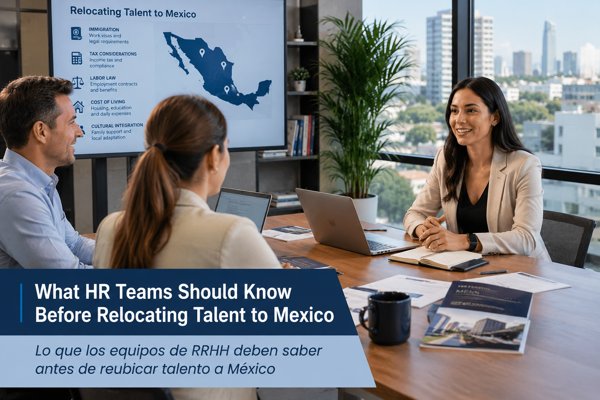
What HR Teams Should Know Before Relocating Talent to Mexico
Mexico continues to attract international investment, manufacturing expansion, and global talent. As nearshoring accelerates and more companies establish operations across the country, HR teams are increasingly being asked to support employee relocations into Mexico.
On paper, the process can appear straightforward: secure a visa, arrange housing, book a flight,move the employee. In reality, successful relocations require far more planning.
The organizations that achieve the best outcomes understand that relocation is not simply a logistics exercise... it's a business strategy.
Immigration Is Only One Piece of the Puzzle
Immigration tends to receive most of the attention during the planning process, and understandably so.
Employees need the proper immigration status before they can legally live and work in Mexico. However, immigration approval is not the finish line. It is simply the starting point.
Housing, healthcare, banking, transportation, tax considerations, and family support all play critical roles in the employee experience after arrival. A relocation can be fully compliant on paper and still struggle in practice.
Location Matters More Than Many Companies Realize
Mexico is not a single market. The employee experience can vary dramatically from one city to another:
- Cost of living.
- Commute times.
- School availability.
- Housing options.
- International communities.
- Healthcare access.
These factors can differ significantly between locations. Choosing the right city—and often the right neighborhood—can have a major impact on assignment satisfaction and retention.
Expectations Should Be Discussed Early
One of the most common sources of frustration is a mismatch between expectations and reality. Employees may arrive expecting one lifestyle while encountering something very different. This does not necessarily mean the destination is problematic, but it does often mean expectations were never fully aligned.
HR teams can reduce uncertainty by providing realistic information about:
- housing markets,
- local costs,
- transportation,
- cultural differences,
- and day-to-day life.
Well-informed employees generally adapt faster and experience fewer surprises.

Don't Focus Only on the Employee
Many relocation programs are designed around the employee's professional needs. Yet, the employee rarely relocates in isolation: partners, children, and even pets often play a major role in how successful an assignment becomes.
Organizations that consider the broader family experience frequently see stronger assignment outcomes and fewer disruptions. Relocation is ultimately a human process, not just an operational one.
Local Expertise Creates Better Outcomes
Even the strongest HR teams cannot be expected to know every destination in detail. Local knowledge often makes the difference between a smooth transition and a stressful one. Questions about neighborhoods, schools, healthcare providers, transportation, or daily life are difficult to answer from another country. Having access to destination expertise helps employees make informed decisions before problems emerge.
Success Should Be Measured Beyond Arrival
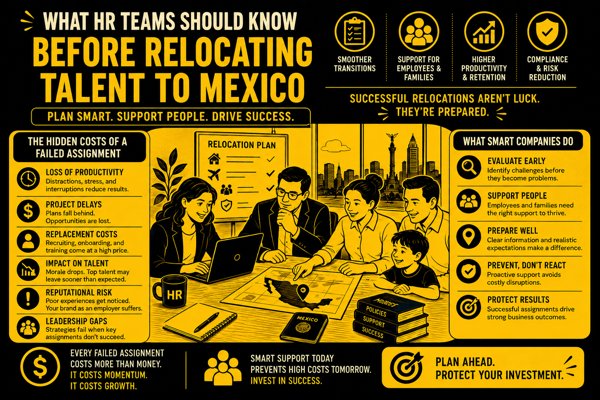
Many companies treat relocation as complete once the employee arrives. In reality, that is when the most important phase begins.
Successful mobility programs track outcomes such as:
- Employee satisfaction
- Assignment completion
- Retention
- Productivity
- Family integration
The goal is not simply getting someone to Mexico. It is helping them succeed once they arrive.
Final Thoughts
Relocating talent to Mexico presents tremendous opportunities for both companies and employees, but successful assignments rarely happen by accident. They require planning, realistic expectations, local knowledge, and ongoing support.
The organizations that recognize relocation as a strategic investment—not merely a logistical process—are often the ones that achieve the strongest long-term results.
Where Nexterra Comes In: Supporting Global Mobility in Central Mexico
At Nexterra, we help companies navigate the practical and human aspects of employee relocation.
From destination guidance and housing support to healthcare, schools, and local integration, we help organizations create smoother transitions and stronger assignment outcomes.
Because successful relocations begin long before arrival.
Next steps:
Why Querétaro Is Becoming One of Mexico’s Most Important Nearshoring Hubs
Global Mobility Challenges in Mexico: What Companies Often Underestimate
Why International Relocation Assignments Fail (And How Companies Can Prevent It)