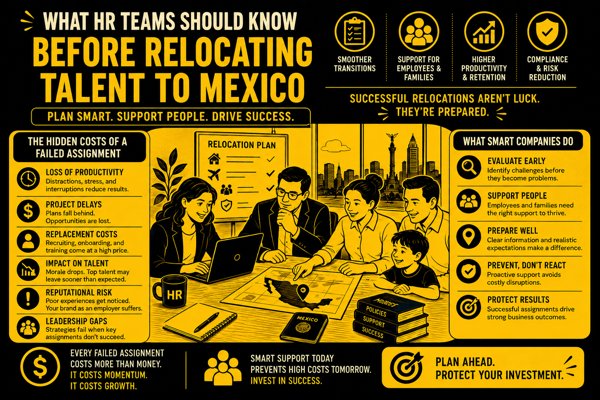



Supporting Accompanying Spouses During Relocation: The Assignment Risk Nobody Talks About
Imagine two employees arriving in Mexico for identical international assignments. They receive similar compensation packages: comparable housing, the same immigration support, the same relocation benefits.
One assignment becomes a success story. The other ends early. What happened? In many cases, the difference has very little to do with the employee. It has everything to do with the spouse.
This is one of the least discussed realities in global mobility. Companies spend enormous amounts of time planning visas, contracts, tax compliance, and logistics. Yet one of the strongest predictors of assignment success often receives surprisingly little attention: the wellbeing of the accompanying partner.
The Employee Gets a Job. The Spouse Gets a Blank Page.
For the employee, relocation usually comes with structure: there is a new role, a new team, a new routine, a clear purpose.
For the accompanying spouse, the experience can look completely different. One day they are a professional, parent, volunteer, entrepreneur, or community member with an established identity.
A few weeks later they may find themselves in a country where:
- They know very few people.
- Their routine has disappeared.
- Their professional future feels uncertain.
- Even simple tasks require extra effort.
The move may have been a joint decision, but the transition is rarely experienced equally.
The Problem Is Not Unhappiness... It's Isolation.
When HR teams think about accompanying spouses, they often focus on practical concerns:
- Can they work?
- Do they have legal status?
- Are there schools for the children?
These questions matter, but the deeper challenge is often social rather than logistical.
People can tolerate inconvenience surprisingly well. What is much harder to tolerate is feeling disconnected. The spouse who feels isolated may begin questioning the move. The employee then feels caught between career opportunities and family wellbeing. Over time, this tension can become one of the strongest threats to assignment stability.
The Hidden Cost of "We'll Figure It Out"
Many relocations begin with optimism. The family assumes they will naturally build a new social circle. The company assumes things will settle with time.
Sometimes they do, but sometimes they do not. The first six months often determine the trajectory of the entire assignment.
A spouse who quickly finds community, purpose, friendships, and confidence is far more likely to embrace the experience. But a spouse who spends those same months feeling alone may begin counting the days until returning home.
Why Modern Mobility Programs Are Changing
The most effective mobility programs today look very different from those of a decade ago. They recognize that relocation success is not measured by arrival. It is measured by adaptation. This shift is changing how companies think about support.
Increasingly, organizations are investing in:
- Cultural integration
- Spouse support
- Destination orientation
- Local networking opportunities
- Family wellbeing
Not because it feels nice, but because it works. The cost of prevention is usually far lower than the cost of a failed assignment.
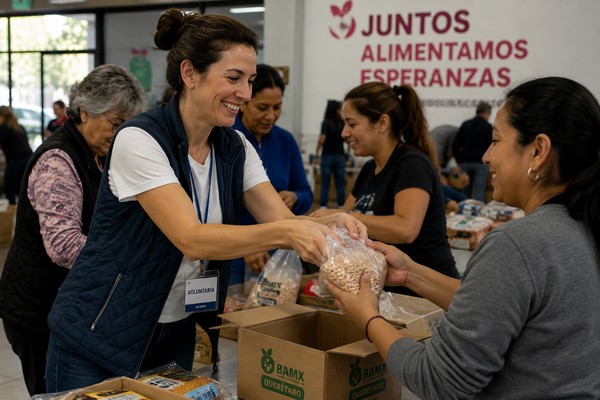
Why Mexico Can Be a Wonderful Place to Rebuild a Life
Mexico presents a fascinating paradox. The culture is generally warm, welcoming, and relationship-oriented. People often form friendships more naturally than in many other countries. Yet newcomers can still feel isolated. Why? Because building a life and building connections are two different things.
The challenge is rarely finding friendly people. It has more to do with finding meaningful belonging. That process takes time, intention, and often a little help.
Querétaro's Unexpected Advantage
This is one reason many international families adapt particularly well to Querétaro.
The city is large enough to offer:
- International communities
- Professional networks
- Cultural activities
- Modern services
Yet it remains small enough that relationships can form relatively quickly. Many newcomers discover something surprising. Within a year, they are no longer navigating the city as outsiders. They are participating in it. And that shift changes everything.
The Real Goal of Relocation
Companies often define assignment success in business terms: project completion, revenue growth, operational performance.
Those metrics matter, but successful relocations are ultimately measured in a more human way:
- Does the employee want to stay?
- Does the family feel at home?
- Can they imagine building a future there?
When the answer is yes, assignments become dramatically more successful.
Final Thoughts
The next time an organization evaluates an international assignment, it may be worth asking a different question.
Not: "Is the employee ready for the move?"
But: "Is the family ready for the transition?"
Because international assignments rarely fail because of one difficult meeting, one housing problem, or one bureaucratic hurdle. More often, they fail quietly. One lonely day at a time.
Where Nexterra Comes In
At Nexterra, we help companies and international families navigate the realities of relocation beyond logistics. From schools and healthcare to cultural integration, community building, and local orientation, we help families establish the foundations that make long-term success possible.
Because helping employees relocate is important. Helping families belong is transformational.
Ask about our Thrive in Querétaro Package:
- Initial interview
- Interests assessment
- Customized recommendations
- Community introductions
- Follow-up session
Next steps:
Why International Relocation Assignments Fail (And How Companies Can Prevent It)
Global Mobility Challenges in Mexico: What Companies Often Underestimate
The Hidden Cost of Employee Relocation Failure: What Companies Often Miss
How Family Integration Impacts International Assignment Success