

Global Mobility Challenges in Mexico: What Companies Often Underestimate
As nearshoring continues reshaping North American supply chains, Mexico has become one of the most important destinations for international talent movement:
- Executives are relocating.
- Engineers are accepting cross-border assignments.
- Specialists are moving with their families.
- Entire teams are being built across multiple countries.
Yet many organizations still approach mobility the same way they did twenty years ago. The assumption is often simple: handle immigration, arrange housing, book flights, and the assignment will take care of itself.
In reality, the most difficult parts of global mobility are rarely logistical. They are human.
The Assignment Starts Long Before the Flight
One of the biggest misconceptions in global mobility is that relocation begins when an employee lands in a new country. In reality, the process often starts months earlier.
The employee is already evaluating uncertainty:
- Will my family be happy?
- Will my spouse adapt?
- Will my children fit into a new school?
- What happens if this assignment fails?
By the time someone boards a plane, many of the emotional challenges have already begun. Organizations that recognize this tend to achieve higher assignment success rates than those focused exclusively on paperwork and compliance.
Mexico Is Easy to Visit. Harder to Understand.
Many international employees arrive in Mexico with confidence: They have vacationed here or have worked with Mexican colleagues. Some may even speak conversational Spanish.
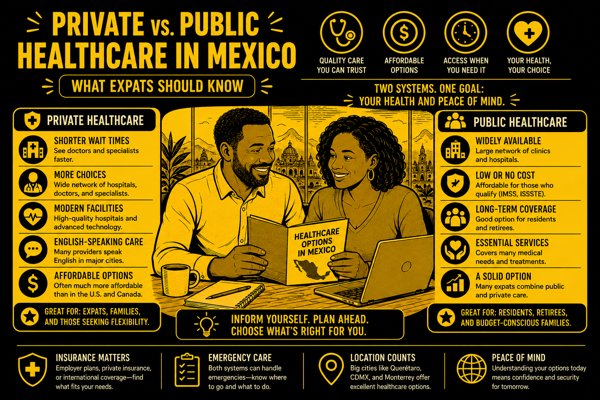
Then real life begins. Suddenly they are navigating healthcare systems, lease agreements, banking requirements, school admissions, tax questions, cultural differences, and unfamiliar business practices.
Mexico is welcoming, but it is also nuanced. The challenge is rarely hostility. The challenge is complexity and a different set of rules, both written and unwritten.

Family Adaptation Is Often the Hidden Variable
Companies frequently evaluate assignments through the lens of employee performance. Yet the strongest predictor of assignment success may not be the employee at all. It may be the family.
A technically successful relocation can quickly become vulnerable if:
- A spouse feels isolated
- Children struggle to adapt
- Healthcare concerns emerge
- Daily life becomes unnecessarily stressful
This is one reason global mobility programs have expanded far beyond traditional relocation services. The conversation is increasingly about integration, not transportation.
The Cost of Failed Mobility Is Higher Than Most People Think
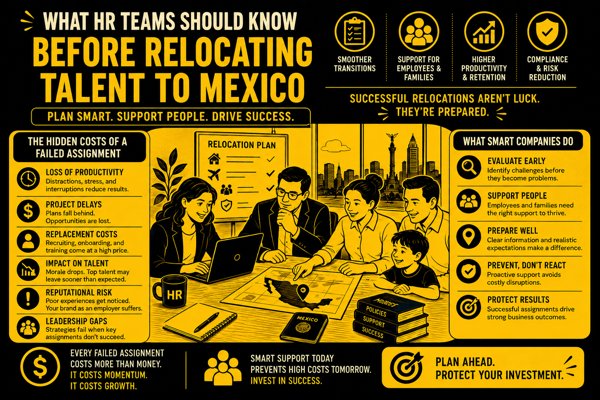
When an international assignment fails, the consequences extend well beyond relocation expenses.
There are direct costs:
- Travel
- Housing
- Immigration
- Recruitment
- Replacement efforts
But there are also less visible costs: Lost productivity, delayed projects, team disruption or maybe even damaged employee confidence.
In some cases, the financial impact of a failed assignment can exceed several times the employee's annual compensation. That reality has pushed many organizations to view mobility as a strategic investment rather than an administrative function.
The New Expectations of International Talent
Today's globally mobile professionals are evaluating destinations differently than previous generations.
Compensation remains important, but quality of life has become equally influential.
Employees increasingly ask:
- Can I build a sustainable life there?
- Can my family thrive?
- Will I have access to quality healthcare?
- What does daily life actually look like?
These questions have become especially important as younger professionals prioritize flexibility, wellbeing, and long-term lifestyle considerations alongside career advancement.
Why Cities Like Querétaro Are Gaining Attention
This shift helps explain why cities such as Querétaro are appearing more frequently in global mobility conversations. The city offers something increasingly valuable: predictability. Not in the sense that everything is perfect, but in the sense that international families can often establish routines relatively quickly.
Modern healthcare, international schools and tons of after-school activities, growing multinational communities, strong infrastructure, and a manageable urban scale create conditions that support adaptation.
For HR leaders, that matters. Because successful assignments are rarely determined by office performance alone. They are determined by what happens after work.
Final Thoughts
Mexico's role in global mobility will likely continue expanding over the next decade. The question for many organizations is no longer whether they will relocate international talent to Mexico. The question is whether they are prepared to support those employees beyond the logistical aspects of the move.
Because visas can be approved, housing can be secured, and flights can be booked, but successful integration requires something much more difficult: helping people feel at home.
Where Nexterra Comes In
At Nexterra, we help companies, executives, and international families navigate the practical and human sides of relocation. From housing and schools to healthcare and cultural adaptation, we help organizations improve assignment success and help employees build sustainable lives in Mexico.
Because the most successful relocation is not the one that gets someone here. It's the one that makes them want to stay.
Next steps:
Why International Relocation Assignments Fail (And How Companies Can Prevent It)
The Hidden Cost of Employee Relocation Failure: What Companies Often Miss
How Family Integration Impacts International Assignment Success