


How Family Integration Impacts Assignment Success
When companies evaluate international assignments, they often focus on the employee: the role, the objectives, the timeline, the expected business outcomes.
But successful assignments rarely depend on the employee alone. They depend on whether the entire family is able to build a life in the new location.
In global mobility, family integration is often treated as a secondary consideration. In reality, it can be one of the strongest predictors of assignment success.
Assignment Success Doesn't End at the Office
An employee may arrive fully prepared for a new role. He or she may have the right experience, technical expertise, and leadership skills.
Yet even highly qualified employees can struggle when family members fail to adapt. When partners feel isolated, children struggle in school, or daily life becomes stressful, those pressures inevitably affect the employee.
The result is often lower engagement, increased stress, and a greater likelihood of assignment disruption.
Integration Creates Stability
Families that integrate successfully tend to develop three things quickly:
- A sense of routine
- A local support network
- Confidence navigating daily life
These factors reduce uncertainty and help families move from "surviving the move" to actually enjoying life in the destination country. That stability allows employees to focus on the reason they were relocated in the first place.
The Business Impact Is Real
Family integration is often viewed as a personal issue. However, its effects are highly visible from a business perspective.
Organizations frequently see benefits such as:
- Improved employee focus
- Stronger retention
- Higher assignment completion rates
- Better overall employee satisfaction
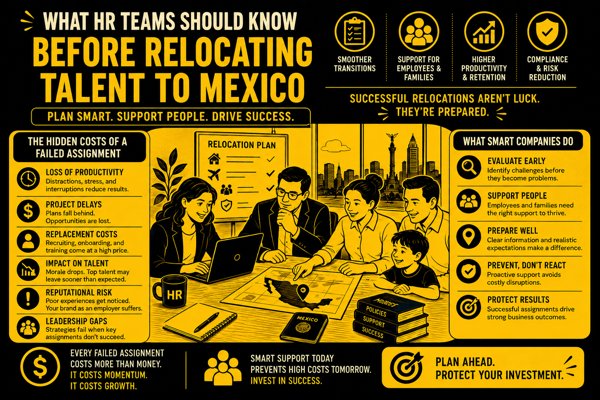
In contrast, unresolved family challenges can create costs that extend far beyond relocation budgets.
Why Local Support Matters
One of the biggest mistakes companies make is assuming that families will naturally adapt over time. Some do. Many need guidance.
Simple support mechanisms can make a significant difference:
- School guidance
- Local orientation
- Community connections
- Healthcare navigation
- Practical destination support
Often, these "preventive" services are inexpensive compared to the cost of a struggling assignment.

Querétaro's Advantage for International Families
Querétaro has become increasingly attractive for international assignments because it offers many of the ingredients that support family integration:
- International schools (American, Swiss, French, Finnish, and many more)
- Family-oriented neighborhoods
- Modern healthcare
- A growing international community
- A manageable size and quality of life
For many families, these factors make it easier to establish roots and feel at home more quickly.
Final Thoughts
Companies often invest heavily in relocating talent. The organizations that achieve the best outcomes understand that talent rarely relocates alone.
Family integration is not simply a relocation benefit. It is a business factor that directly influences assignment success, employee retention, and long-term organizational performance. Because when families thrive, assignments thrive too.
Where Nexterra Comes In: Supporting Global Mobility in Mexico
At Nexterra, we help companies support employees and their families throughout the relocation journey.
From schools and healthcare to local orientation and community connections, we help families settle faster and build the foundations for long-term success.
Because successful assignments start with successful integration.
Next steps:
Why International Relocation Assignments Fail (And How Companies Can Prevent It)
Global Mobility Challenges in Mexico: What Companies Often Underestimate
The Hidden Cost of Employee Relocation Failure: What Companies Often Miss